The total solar eclipse of August 12, 2026
Why do Iceland and Spain get two minutes of darkness while London only gets a dent in the Sun?
On August 12, 2026, the Moon's shadow races across Earth from the Arctic to Spain. Inside a strip about 300 km wide, the Sun disappears completely for about two minutes. Everyone else in Europe sees a partial eclipse. You can fly through the whole event in Luna, a free browser simulator, and check any location yourself.
About 20 minutes self-guided.
Make a prediction first
The Moon is 3,474 km wide. When it blocks the Sun, how wide is the dark spot it casts on Earth? Wider than the Moon, about the same, or much narrower? Write your answer down before you open the simulator. You will check it against what you see.
What happens on August 12
A solar eclipse happens when the Moon passes exactly between the Sun and Earth, and the Moon's shadow falls on Earth's surface. The shadow has two parts. The umbra is the small dark core where the Moon covers the whole Sun. The penumbra is the wide pale region around it where the Moon covers only part of the Sun.
On August 12, 2026 the umbra first touches Earth in the Arctic, crosses Greenland and Iceland, moves over the Atlantic, and reaches Spain in the evening. The deepest point of the eclipse comes at 17:46 UTC, just west of Iceland. There the path of totality is 294 km wide and totality lasts 2 minutes 18 seconds.[1]
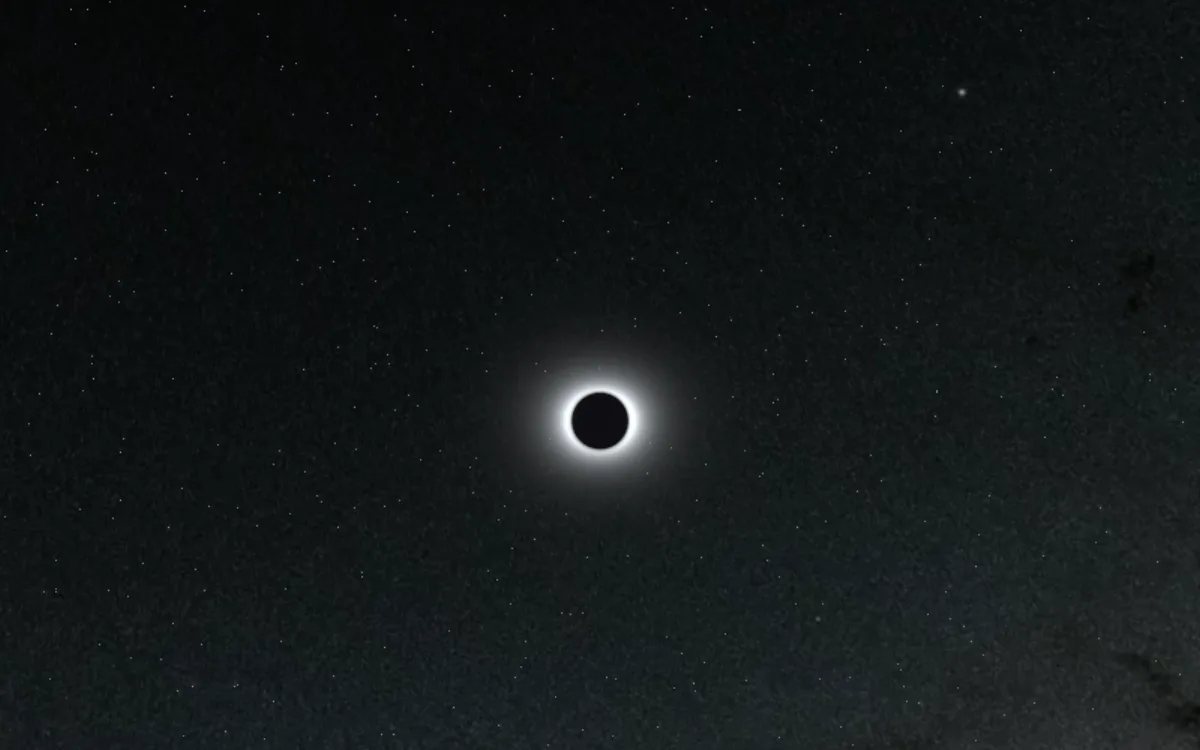
Inside that strip, the sky darkens, the temperature drops, and the Sun's corona appears: a pale ring of light around a black disc. Outside the strip, the Moon takes a bite out of the Sun but daylight continues. That is a partial eclipse, and it is what most of Europe gets.[2]
| City | Total or partial | Coverage of the Sun's disc | Time of maximum (UTC) |
|---|---|---|---|
| Reykjavik, Iceland | Total | 100% | about 17:48 |
| Zaragoza, Spain | Total | 100% | about 18:29 |
| Madrid, Spain | Partial | 99.97% | about 18:32 |
| Lisbon, Portugal | Partial | about 94% | about 18:36 |
| Dublin, Ireland | Partial | about 94% | about 18:10 |
| Paris, France | Partial | about 92% | about 18:17 |
| London, UK | Partial | about 91% | about 18:13 |
Try it in Luna
The simulator starts you above Earth on August 12, 2026, a few minutes before the shadow arrives. Time runs fast enough to watch the shadow move, and you can drop it back to realtime whenever you want.
- Press Launch in Luna. You are looking at Earth, with the eclipse about to start.
- Watch the globe. Find the dark core of the shadow and the wide pale region around it, and compare their sizes. Was your prediction right?
- Open the location explorer and pick Reykjavik. Read what it reports: total or partial, coverage, contact times, and how high the Sun stands.
- Now pick Madrid and compare its numbers with Reykjavik's.
- Press View from here at Reykjavik and watch the Sun as time advances: partial phase, about two minutes of totality, then the light returns.
- Do the same from Madrid. The Sun never fully disappears there. Madrid reaches 99.97 percent covered and still never shows the corona.
What to record
- For Reykjavik, Madrid, and London: total or partial, coverage, and time of maximum in UTC.
- The Sun's height at maximum for Reykjavik and for one Spanish city.
- One thing you saw in the sky at Reykjavik during totality that never happened in Madrid.
Why the path of totality is so narrow
The Sun is not a point of light. It is a glowing disc about 400 times wider than the Moon and about 400 times farther away. Light streams past the Moon from every part of that disc, so the Moon's full shadow narrows to a cone behind it. By the time the cone reaches Earth, only its tip is left. That tip is the umbra: a spot a few hundred kilometers wide, cast by a Moon 3,474 km wide. The penumbra, where only part of the Sun is hidden, stays thousands of kilometers wide. That is why totality is rare for any single place while partial eclipses are common.
Why 99 percent is not totality
The Sun's surface is blindingly bright. Even at 99 percent covered, the remaining sliver keeps the sky blue and drowns out the corona. Madrid is a good test of this: it reaches 99.97 percent, close enough that the arithmetic says almost nothing is left, and it still gets a bright evening rather than a corona. Only when the Moon covers the last of the disc does the sky turn to deep twilight and the corona appear. People who have stood in both will tell you a deep partial eclipse and a total eclipse are different events. In the simulator you can switch between Madrid and Reykjavik in seconds and see the difference for yourself.
What Luna models
- Real Sun and Moon positions from a validated astronomy library (accuracy target: within one arcminute).
- The umbra and penumbra computed from the true geometry of the two discs, not a drawn animation.
- Contact times that match NASA's published minute-level values to within about two minutes. These come out of the running simulation, not a pre-recorded animation.
- Sun altitude for any location, so you can see that Spain gets a low evening eclipse.
What Luna leaves out
- Weather. Luna cannot tell you whether it will be cloudy.
- Street-level path edges. Mountains on the Moon shift the real edge of totality by a few kilometers, so if you are near the edge, check a dedicated eclipse map. Terrain elevation is on the list, one thing at a time.
- Local clock time. All times are UTC.
- Physical sky brightness. The darkening during totality is tuned to look right on a screen, not a lux model.
Watching the real eclipse safely[2, 4]
Luna is a simulator, not local observing advice. The guidance below is NASA's, from its eclipse safety page.
- During every partial phase, look at the Sun only through eclipse glasses or a handheld solar viewer that meets the ISO 12312-2 standard, or use an indirect method such as a pinhole projector.
- Ordinary sunglasses are not safe, no matter how dark.
- Never look at the Sun through a camera, telescope, or binoculars while wearing eclipse glasses. Concentrated light burns through the filter and injures your eye. Optical equipment needs a proper solar filter mounted on the front.
- On totality, NASA writes: “You can view the eclipse directly without proper eye protection only when the Moon completely obscures the Sun’s bright face, during the brief and spectacular period known as totality. (You’ll know it’s safe when you can no longer see any part of the Sun through eclipse glasses or a solar viewer.)” Read NASA's full guidance before the day.
- With a pinhole projector, look at the projected image on the ground or wall. Never look through the pinhole at the Sun.
Questions and answers
Do I need eclipse glasses if I am in the path of totality?
Yes. The partial phases before and after totality last over an hour, and they are as dangerous to watch unprotected as the Sun on any other day. For when eye protection can come off, follow NASA's eclipse safety guidance rather than anything written here.
What will I see from my city?
Open the location explorer in the simulator and pick your spot. It reports whether you get a total or partial eclipse, how much of the Sun is covered, the times in UTC, and how high the Sun will stand.
Why does the eclipse happen in the evening in Spain?
The shadow track ends in Spain. It arrives there around 18:30 UTC, which is 20:30 local summer time, so the Sun is already low in the west and close to setting.
Why isn't there an eclipse every new moon?
The Moon's orbit is tilted about five degrees against Earth's orbit around the Sun. At most new moons the shadow passes above or below Earth and nobody sees anything.
Is it worth traveling from 99 percent coverage to the path of totality?
If you can reach the totality strip, go. Madrid reaches 99.97 percent and still only gets a slightly dim evening; the corona needs the last of the disc gone. Madrid to Zaragoza is about 300 km, and on eclipse day that distance decides which of the two events you experience. I am still weighing a 17 hour drive for this one, and otherwise planning ahead for 2027.
When is the next total solar eclipse after this one?
August 2, 2027, with totality crossing southern Spain, North Africa, and the Arabian Peninsula.