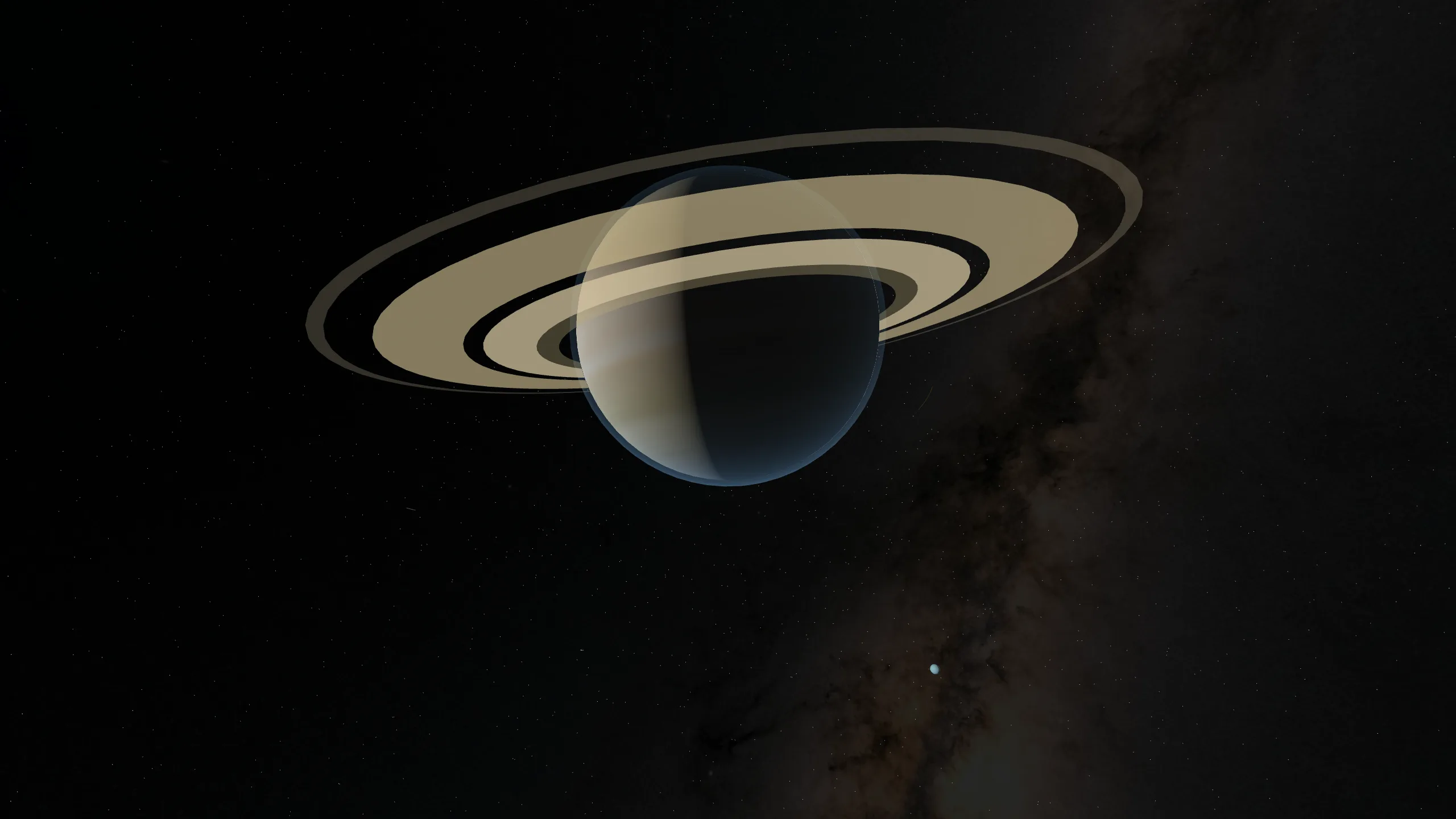
Luna Space Simulator
A space simulator with real gravity
Free to use in desktop and mobile browsers.
Educators: if you use Luna in a classroom or lecture hall, a few sentences from you would help me get funding to build out Luna's teaching tools. It costs you nothing, and you'd have a say in what gets built. Get in touch with your name, institution, and how you use it.
Luna simulates the Solar System with full N-body gravity: every star, planet, and major moon pulls on every other. Drop a second Jupiter next to Earth, or crank up the Sun's mass, and every orbit responds in real time.
There's also Rocket Academy for building and staging rockets until one reaches orbit, and a scattering playground where mixing atmospheric gases shows why Earth's sky is blue and Mars's is butterscotch. You can visit Kepler-16, where a planet orbits two stars, or follow the lessons if you want the orbital mechanics explained.
Coming soon: robot simulations and a free-flight mode.
How the simulation works
The planets and major moons are integrated with a symplectic N-body method that keeps energy drift bounded over long runs. Past fifty massive bodies the simulation switches to Barnes-Hut and keeps running at interactive speeds. A close encounter can slingshot a moon away or capture a passing body. Planets render enlarged by default so you can find them; true-to-scale mode is one click away in the toolbar. Read more about how it was built.
Things to try
Give the Sun a companion star and find out which planetary orbits survive. Send a rogue star through the inner Solar System. Open the galaxy map and jump to another star system. Recreate the total solar eclipse of August 12, 2026 from anywhere on Earth.
Learn with it
The guided lessons build up orbital mechanics step by step, starting with how orbits work. The 2026 eclipse page links printable classroom materials: a student investigation, a facilitator guide, and an answer key. Luna is translated into German, Spanish, French, Hebrew, and Indonesian.
Is the physics real?
Yes. Orbits come out of a live N-body integration, and a spawned body of meaningful mass always affects the rest of the system. The educational mini-modes state their simplifications in their own screens.
Does it run on phones?
Yes, in any modern mobile browser. Texture quality adapts to the device.
What does it cost?
Luna is free. If you want to support development, there is a support button in the app.
News
July 31, 2026
Luna now opens with this page instead of dropping you straight into the simulator, so you can read what it is before you launch it. Updates about new features will be posted here. I also make videos on YouTube and write about my other projects at alikarpuzoglu.com.