
What makes Kepler-16 unusual?
Kepler-16b was the first transiting planet confirmed to orbit both stars in a binary system. It is often compared with the fictional world Tatooine because a view from the system could include two suns, but Kepler-16b itself is a cold gas giant roughly the size of Saturn, not a desert planet with a solid surface.
The larger star is an orange K-type dwarf and the smaller companion is a red M-type dwarf. They complete an orbit around their shared center of mass in about 41 days. Farther out, Kepler-16b takes about 229 days to orbit the pair.
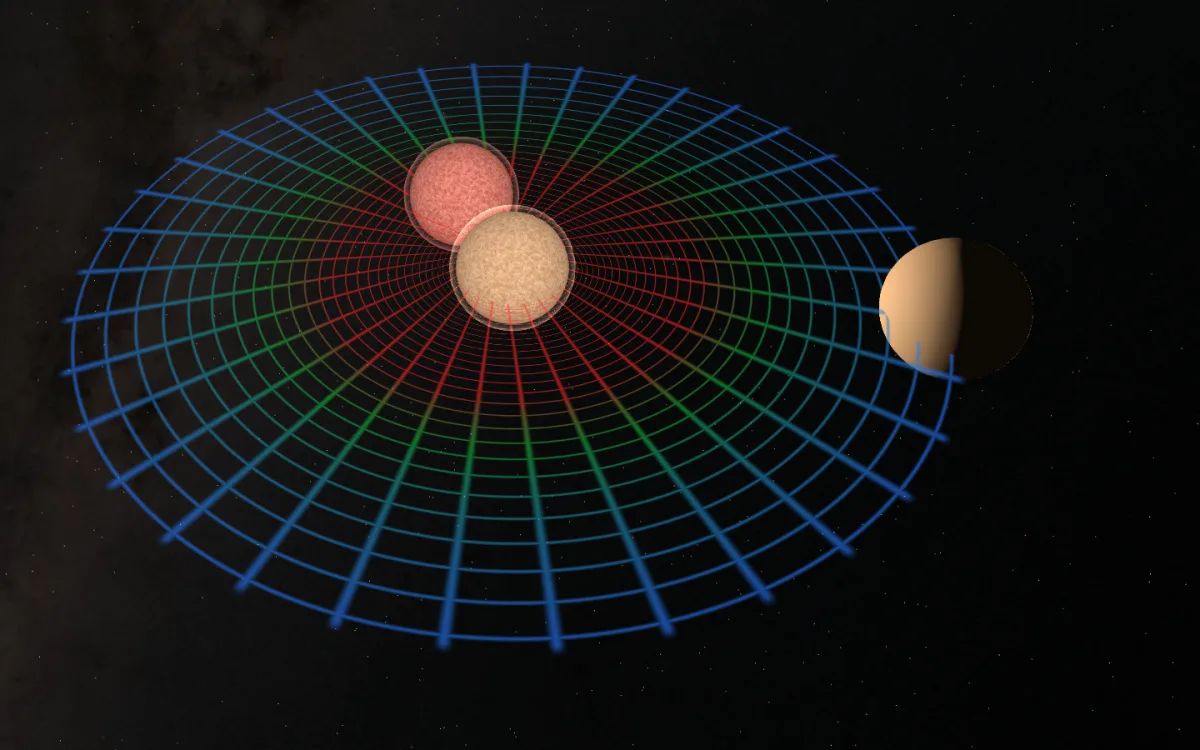
What Luna models
The preset initializes the stars with masses of approximately 0.690 and 0.203 times the Sun's mass and a binary separation of 0.224 astronomical units. The planet begins at about 0.705 astronomical units with roughly one third of Jupiter's mass. Luna then advances the bodies with mutual Newtonian gravity.
Because the two stars have different masses, the smaller star follows the wider path around their barycenter, or common center of mass. The planet travels around the binary as a whole. Speeding up time makes the stellar motion easy to compare with the planet's longer year.
What to look for
- Find the point between the stars that both stars orbit. It lies closer to the heavier star.
- Compare the compact 41-day stellar orbit with the much wider planetary orbit.
- Select each body and watch how none of the massive objects is completely motionless.
Question to test
Which star should move faster around the barycenter: the heavier star or the lighter star? Predict first, then use the simulation to check.
Model limits and sources
Luna is an educational real-time model, not a precision ephemeris for predicting every transit. The preset simplifies the observed system's three-dimensional orientation and runs it as an interactive Newtonian approximation. Visual body sizes are not shown at the same scale as orbital distances.
The preset's parameters come from the 2011 discovery analysis by Doyle and collaborators. For an accessible overview and updated context, read NASA's page about Kepler-16b and its two stars.